Blog
A watch that is not animated
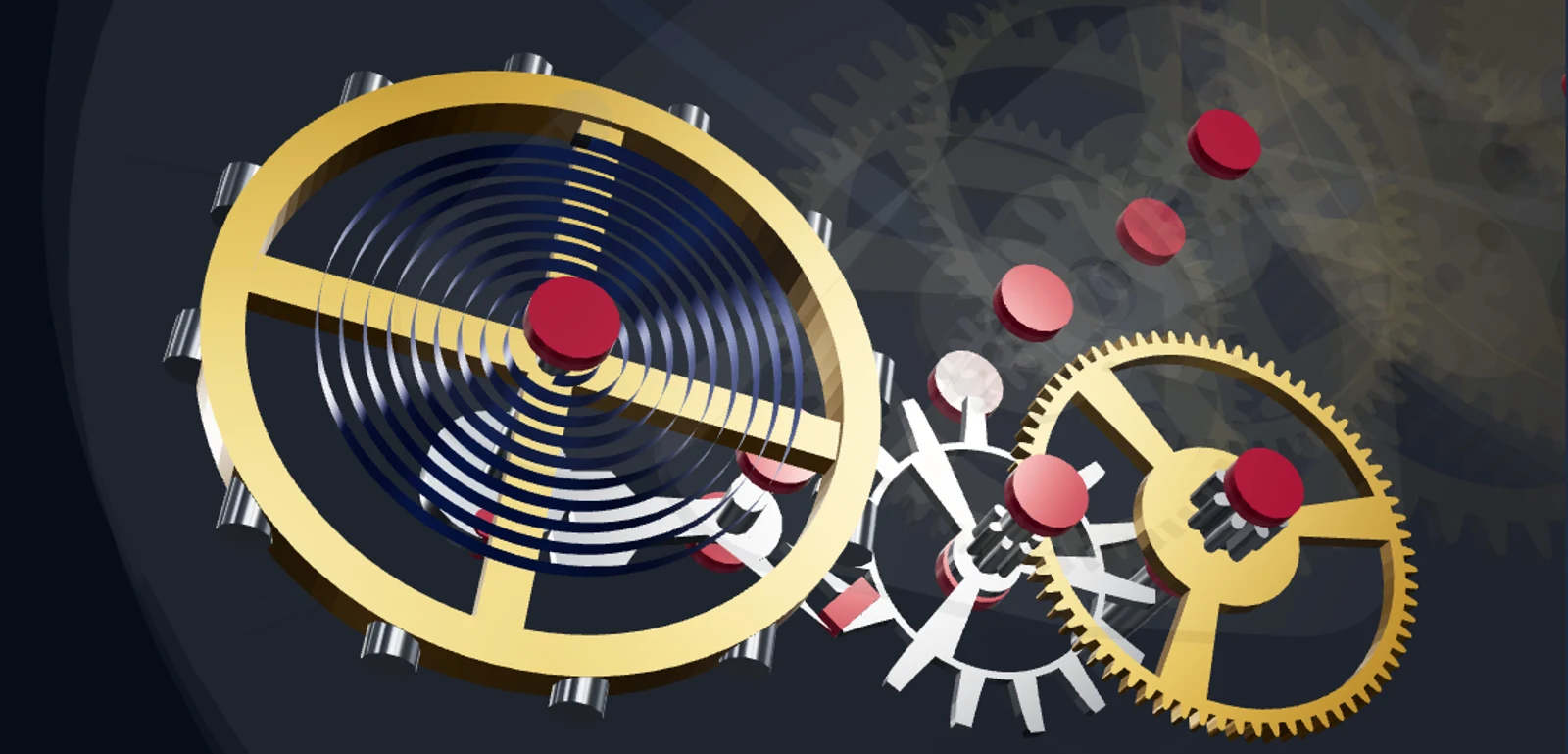
drag to rotate · drag the crown to wind and set · click any part to fade it
Goingstopped
—
- Rate
- —
- Beat
- 18000 /h
- Reserve
- 0 min
- Torque
- 0 nN·m
Self-windinglosing
- Rotor
- —
- Reduction
- 100:1
- Winding
- 0.00 turns/h
- Spending
- 0.00 turns/h
- Balance
- —
- Slipped
- 0 turns
Adjustmentthe only two a watch has
Partsclick to select · fade to see behind
Everything in there is turning because something else pushed it. Drag the crown to the right of the case and you will feel the mainspring take up; pull the crown out and drag again and the hands move while the seconds hand carries on undisturbed. Set the Wrist control to Walking and the watch will wind itself. Click any part to fade it and see what is underneath.
The one thing worth knowing before anything else: there is no animation in this. Nothing has a keyframe, nothing is told what angle to be at, and the seconds hand is not advancing once a second because a timer fired. A balance wheel is solving an equation of motion at five thousand steps a second, an escapement is converting its swings into rotation, and the hands are geared off the result. If the rate comes out wrong, it comes out wrong, and you can watch it happen.
It comes out 0.6 seconds a day slow, which is a genuinely good watch.
What a watch actually is
Four things, in a chain, and almost all the confusion about mechanical watches comes from not separating them.
A mainspring stores energy and gives back a torque. A going train is a set of gears, and gears are boring: they only multiply speed and divide torque. An escapement is where the interesting part is. And a balance wheel is a thing that vibrates at its own frequency and does not much care what you do to it.
The order matters, and so does which of them decides the rate. It is the balance, alone. The mainspring and the train have nothing to do with timekeeping; their entire job is to keep handing the balance small pushes so it does not stop. The escapement is the awkward middleman that has to take a steady torque coming in and turn it into discrete shoves timed by the balance itself — while also holding the entire train still for nine tenths of the time, and counting.
The train is arithmetic
The tooth counts are not chosen for looks. They have one job, which is to make the centre wheel turn exactly once an hour and the fourth wheel exactly once a minute, out of whole numbers of teeth.
| Teeth | Driven pinion | Ratio | |
|---|---|---|---|
| Barrel | 80 | 10 | 8 |
| Centre wheel | 64 | 8 | 8 |
| Third wheel | 60 | 8 | 7.5 |
| Fourth wheel | 70 | 7 | 10 |
From centre to escape that is , so the escape wheel turns 600 times an hour. It has 15 teeth, and each tooth is let past in two stages — one for each pallet — so a turn of the escape wheel is 30 beats:
which is five a second, which is a balance vibrating at 2.5 Hz. That number is not an input to the simulation anywhere; it is what the tooth counts produce. The harness measures 17,999.88 beats an hour by counting them.
The same arithmetic gives the power reserve for free. Barrel to escape is , and the barrel turns once every eight hours, so five and a half turns of wind is about forty-four hours. Measured: 44.2 hours, of which 35.3 are above 200° of amplitude, which is the part a watchmaker would call useful.
The balance is a pendulum that does not care
This is the whole of the timekeeping:
A hairspring pulling back proportionally to angle, two drag terms, and whatever the escapement is doing at this instant. Integrated with Euler–Cromer at a fixed 0.2 ms step, which is symplectic and therefore does not leak energy — an ordinary Euler step would have the watch gaining or losing minutes a day from arithmetic alone.
The reason a watch works at all is in the first two terms. A linear spring gives a period that does not depend on amplitude, so a balance swinging 280° and a balance swinging 200° keep the same time. That is isochronism, and it is why a watch can run for forty hours on a torque that falls by two thirds over that span and still be worth wearing.
It is not perfect here, and it is instructive that it is not:
| Wind | Amplitude | Rate |
|---|---|---|
| 5.5 turns | 287° | −0.6 s/day |
| 3.0 turns | 251° | −2.7 s/day |
| 1.5 turns | 216° | −3.0 s/day |
| 0.6 turns | 175° | −6.3 s/day |
The hairspring in here is perfectly linear, so every one of those six seconds comes from the escapement — from the fact that unlocking costs the balance energy at a moment that depends on how fast it is going. Real watches have this defect too, from the same place, and a large part of what an adjuster is doing is trading it off against the hairspring’s own errors.
The escapement, which is the hard part
The Swiss lever escapement does four things per beat and they are worth naming, because the simulation’s phase indicator tells you which one it is in.
Lock. An escape wheel tooth is resting against the flat of a pallet jewel. The whole train is stationary, held by a wheel that wants to turn and a jewel that will not let it. The jewel’s face is cut at an angle that makes the tooth pull the fork harder onto the banking pin rather than pushing it off — this is draw, and without it every jolt to the watch would unlock the escapement and it would run away.
Unlock. The balance swings back through the middle, and a jewel on its roller catches the fork’s slot and shoves the fork sideways. This costs the balance energy. It is the price of admission.
Impulse. The lock releases, the escape wheel surges forward, and its tooth slides along the sloping face of the pallet, driving the fork — which is still engaged with the balance’s roller jewel — and pushing the balance on its way. This is the only moment in the entire beat when the mainspring’s energy reaches the balance. It lasts about 52° of swing out of the 570° the balance covers in a beat — under a tenth of it.
Drop. The tooth falls off the end of the pallet, the wheel turns until the next tooth hits the other pallet, and everything stops again. The balance is now detached — free, unconnected to anything, swinging out to 280° and back with nothing touching it. That is the whole point of the design and the reason it beat every escapement that came before it.
Modelling this properly turned out to need one idea, which is to stop thinking of the escapement as a force and start thinking of it as a rigid coupling. While the tooth is on the pallet, the escape wheel’s position is a function of the balance’s position — call it — and there is no freedom left. So the torque the balance feels is just the torque on the escape wheel scaled by the gearing between them:
Unlocking and impulse then fall out of one expression. During unlocking the balance is pushing the wheel backwards, so that derivative is negative and the balance loses energy. During impulse it is positive and the balance gains. Nobody has to write down two cases and decide when to switch between them; the sign of a derivative does it.
Checking it without looking at it
Before any of it was drawn, there was a headless harness that ran the movement and printed numbers, and it earned its keep immediately.
The most useful check in it is an independent one. Rather than only integrating until the amplitude settles, the harness also solves for where it should settle, by balancing the energy the escapement puts in per beat against the energy the two drag terms take out, and bisecting on amplitude. That prediction has no integrator in it at all, and it agrees with the integrated result to within a degree everywhere from 135° to 287°. Two different methods reaching the same number is worth a great deal more than one method reaching a plausible one.
It also caught the bug I would never have found by eye. The rate came out at exactly −86.3 seconds a day, and — this is the tell — it stayed at exactly −86.3 no matter what I changed. Different amplitude, different torque, different mainspring: −86.3. A physical error would have moved.
The beat period is 0.2 s and the timestep is 0.2 ms. The escapement code was returning early when it released the tooth, skipping the balance’s integration for exactly one step per beat. One missing line, one part in a thousand, and a watch that would have lost an hour and a half a month.
The rotor, added later, produced two more that the harness caught and the screen never would have.
The first was a perpetual motion machine made of stiction. The winding load resists the rotor only while the rotor is moving, so I wrote it as a torque opposing the current direction and zeroed the rate when the load reversed it inside a step. That reads as sensible and is a ratchet: stopped means no load, no load means it accelerates freely, moving means the load reverses it, which means stopped. Each cycle of that accumulates a little , and is what winds the watch. It wound a dead mainspring to full in half an hour off nothing but the integrator. The fix is to treat the load as what it is — dry friction — and integrate it that way: find where the rotor would go unresisted, then let the load take away at most enough to stop it dead. A stalled rotor then stays exactly stalled.
The second only showed up in the comparison between the two integrators. At high speed the balance is replaced by its own steady state, but a rotor has no steady state to jump to — it is driven by a wrist, not by a spring — so the fast path runs a couple of seconds of wrist motion properly and takes the average. That works. What did not work was that I then spun the rotor’s drawn angle forward to cover the rest of the slice, which felt like a cosmetic detail and quietly overwrote the physical state the next sample would start from. Every sample began with the rotor dropped somewhere it would never have been, measured it falling out of that position, and reported the fall as the winding rate. The watch wound about twice as fast as it should, consistently enough to look deliberate. The two integrators now agree to within 1% at every activity and every state of wind, which is the check that found it and the check that says it is fixed.
There is a whole class of error, though, that none of this could ever catch, because the physics does not have a body in it. Every wheel is an angle and a tooth count; nothing in the equations notices when two solids are in the same place. The winding stem ran straight through the barrel’s toothed rim for weeks and every number came out right, because the stem’s job is to turn the crown wheel and it was turning it perfectly — three millimetres into the middle of another part. So there is now a second harness that asks a different question: not whether the movement runs, but whether it could be built. It reduces each part to a handful of solids of revolution — a circle or an annulus in plan, swept through a band of height — and checks all 351 pairs for two that overlap in plan and in height. Pairs that are supposed to be in contact, because one drives the other or because they share an arbor, are named and skipped. Everything else has to miss.
The first run found fourteen collisions, and the interesting thing is how ordinary they were. Two of them were the stem. Two were pinions that had grown just far enough to graze a wheel they were never meant to touch, by eighteen microns. One was a bridge with no hole in it for an arbor that had to pass through. None of these are subtle once stated and none of them are visible from any angle you would think to look from.
Laying it out
A gear mesh fixes exactly one thing: the distance between two arbors is the sum of their pitch radii. So the plan of a movement is a chain of rigid links with free joints, and designing one is choosing the angles.
I tried to choose them by hand and kept producing watches where the balance overlapped the barrel or the escape wheel sat outside the case. The five angles in there now came out of a grid search and coordinate descent against the obvious constraints — everything inside a 27 mm case, no two arbors closer than a couple of millimetres, the escapement not buried. Every mesh distance is exact, and two things fell out that I did not ask for: the fourth wheel landed at almost exactly six o’clock, which is where a subsidiary seconds dial belongs, and the crown wheel landed on the stem’s axis, which it has to, because the bevel between them only works if the axes meet.
The teeth themselves taught me something too. My first attempt scaled the tooth profile by the wheel’s radius, and the 64-tooth centre wheel came out looking like a circular saw. A tooth’s size is set by the pitch — the distance from one tooth to the next — not by how big the wheel is, which is why watchmakers measure it in modules. Once the profile was expressed in modules, the big wheel and the seven-leaf pinion got teeth of nearly the same size, and the thing stopped looking like a toy.
Winding, and the trick that makes it keyless
The crown does two completely different jobs and does them with one part sliding a millimetre and a half.
Pushed in, the sliding pinion is coupled to the winding pinion by a ring of facing ratchet teeth. Turning the crown turns the winding pinion, which drives the crown wheel through a bevel, which drives the ratchet wheel, which is screwed to the barrel arbor and winds the mainspring. The click drops between the ratchet wheel’s teeth and stops it unwinding. Turn the crown the other way and those facing ratchet teeth simply ride over each other, which is why winding backwards does nothing but click.
Pulled out, the sliding pinion leaves the winding pinion behind and takes up with the setting wheel instead, which reaches through the plate to the minute wheel and moves the hands.
Here is the part that is genuinely clever. The minute hand is not fixed to the centre wheel; it is on a cannon pinion, which is a friction fit on the centre arbor — tight enough to be dragged round by it for forty hours, loose enough to be twisted against it by hand. So setting the time slides the hands past a train that never stops. The harness checks exactly this: five turns of the crown while pulled out moved the hands 60 minutes and moved the train by 0.0000 seconds. That is why the seconds hand does not flinch while you are setting a watch.
Winding it from empty takes 14.15 turns of the crown for five and a half turns in the barrel, which is about right, and about as tedious as the real thing.
Why the whole works rides over the barrel
The keyless works is the one part of the movement with nowhere to go. The crown wheel has to mesh the ratchet wheel, which puts it within the sum of their two pitch radii — four millimetres — of the barrel’s arbor. The barrel is 5.8 millimetres in radius. So the crown wheel is always somewhere over the barrel’s lid, and the stem that reaches it always crosses the barrel, and no choice of angle anywhere in the layout changes that. Making the ratchet bigger does not help, either: it pushes the crown wheel outward, but the winding pinion sits one crown-wheel radius back along the stem, so it moves inward faster than the crown wheel moves out.
Which leaves height. The stem goes up and over, clearing the barrel’s lid by four tenths of a millimetre, and everything it drives goes up with it — the crown wheel, the ratchet, the click, and the whole automatic module stacked on top of those. The one part that cannot go up is the setting wheel, because it has to reach down through to the minute wheel under the dial, and an arbor that long would spear the barrel and the mainspring inside it. That one is fixed in plan rather than in height, by putting the setting wheel on the far side of the stem from the barrel, where its arbor comes down outside the barrel’s rim with eight hundredths of a millimetre to spare.
This is the kind of thing that is obvious in a real movement and invisible in a drawing. The parts are not flat.
Winding it without touching it
Now put it on a wrist. The Wrist control at the top decides what the wearer is doing, and everything downstream of it follows.
The part doing the work is the rotor: a crescent of tungsten on a ball race, free to swing either way about the middle of the watch. Fade it up to solid and you can see how much of the movement it covers, which is the standing complaint about automatics and the reason so many of them are skeletonised.
The first thing to get straight is what actually turns it, because the obvious answer is wrong. A rotor does not spin because your wrist spins it. It spins because your wrist spins the watch while the rotor, hanging on a very good bearing, more or less stays where it was. The winding is the difference between the two. That is why the equation of motion is written in the watch’s own frame, with the rotor’s angle relative to the watch and the watch’s own rotation:
That last term is the whole idea. It is the Euler force — the watch turning out from under the rotor — and it is not a correction to the gravity term, it is a peer of it. A rotor on a good enough bearing barely needs gravity at all.
The second thing is that is not gravity. It is the specific force: gravity minus the frame’s acceleration, which is what an accelerometer reads and what a weight on a pivot actually responds to. Modelling only gravity would mean the rotor could be driven by tilting the watch and by nothing else, and that gets walking badly wrong, because a good half of the energy in a swinging arm is in the acceleration rather than the change of angle.
So the wrist model is an arm swinging as a pendulum, and each activity carries two numbers that have to be kept separate: how far the watch turns, and the radius of the arc it travels on. An arm swinging from the shoulder carries the watch on a 60 cm arc and throws it about. A hand turning over at a keyboard rotates the watch just as far while barely moving it anywhere. Collapse those into one number — which is what I did first — and desk work comes out either as no winding at all or as half a g of shaking, depending on which end you tune it from.
And leave the watch on a table and nothing happens at all, which falls straight out of the same equations rather than being a special case. Lying dial up, gravity points down the rotor’s axis, where the rotor has no leverage on it whatsoever. Every preset carries a lean — how much of gravity lies in the plane the rotor turns in — and for the table it is zero.
A hundred to one, and why it cannot be fewer stages
Here is the number that shapes the whole module. The mainspring at full wind wants 2.3 mN·m at the barrel. Referred back through the automatic work at 55% efficiency, the rotor has to pull against
and the most the rotor can ever offer is , which for a few grams of tungsten at seven tenths of a 12 mm radius is about 235 µN·m. Set and the load is 42 µN·m — a margin of 5.6, which sounds generous and is not, because the rotor only makes its full torque when it is lying sideways and makes none at all at the bottom of its swing. A rotor that could only just wind a slack mainspring would give up half way up.
A hundred to one cannot be done in one stage. A wheel-and-pinion pair on a 2 mm wheel gets you about five to one, and the reversing wheel contributes nothing at all to the ratio because it is a pure idler — its tooth count cancels. So it is three meshes: a 9-leaf rotor pinion into a 45-tooth reduction wheel, an 8-leaf reduction pinion into a 40-tooth reversing wheel, and a 9-leaf reversing pinion into the same 36-tooth ratchet wheel the crown winds through. Five times five times four is exactly a hundred, and a full wind is 550 turns of the rotor.
Finding somewhere to put those two wheels was the same problem as laying out the going train, and more constrained, because both ends were already nailed down: the rotor turns about the middle of the watch and the ratchet wheel is on the barrel arbor. Three fixed link lengths and one free angle. Sweeping that angle and asking which setting left the most room put it at 141.5°, which drops the module into the empty quadrant above the barrel with both new pivots about 1.7 mm clear of the click’s.
What surprised me was how little else constrains it. The automatic work sails straight over the ratchet, the click, the crown wheel and half the going train without touching any of it, purely by being a millimetre higher up — which is why a module like this can be bolted onto a hand-wound calibre, and why historically so many of them were. Only two kinds of thing actually conflict: bodies that share a level, and arbors, which have to run down through every level to a pivot and so collide with everything on the way.
The reverser and the bridle
Two more parts exist because the rotor is not a crank.
The reverser is why the rotor winds in both directions. Whichever way it goes, one pawl bites and the other free-wheels, so the ratchet wheel only ever turns the winding way. Early automatics that wound in one direction only threw away half of every swing. In the model this is just , but it is visible in the scene: the rotor pinion and the reduction wheel follow the rotor, backwards and all, while the reversing wheel follows the ratchet, which only goes one way. The two disagree, and the disagreement is the reverser.
The slipping bridle is why a rotor cannot burst a mainspring. The spring’s outer end is not hooked to the barrel wall; it is pressed against it by friction. Walk for an hour with a full spring and the arbor keeps turning and the outer end simply slides. The model keeps the turns wound in and the turns slipped away as separate quantities, so the arbor angle carries on climbing — the ratchet wheel really does keep turning — while the tension sits pinned at 5.5. Select the Slipping bridle and watch the band creep round the barrel wall; that creep is a rotor winding into nothing.
What the numbers say
Running each activity headlessly, against an empty barrel and then against a full one:
| Wrist | Rotor | Turns/h in | Spent/h | From dead |
|---|---|---|---|---|
| On the table | 0 rpm | 0.00 | 0.125 | never |
| Worn, sitting still | 1 rpm | 0.83 | 0.125 | stalls at 0.4 turns |
| At a desk | 9 rpm | 5.46 | 0.125 | full in 2.0 h |
| Walking | 22 rpm | 13.1 | 0.125 | full in 0.7 h |
| Walking briskly | 46 rpm | 27.9 | 0.125 | full in 0.3 h |
| Running | 95 rpm | 56.7 | 0.125 | full in 0.2 h |
The going train costs an eighth of a turn an hour. Walking supplies a hundred times that. An automatic does not politely top itself up — it overwhelms the watch, and then slips, and spends essentially its whole life pinned at full wind. Eight hours of walking from full gives up 56 turns at the bridle.
The two rows at the top are the interesting ones. Worn but motionless, the rotor winds — and then stalls at four tenths of a turn and stays there, because it is only ever driven by the misalignment between where it hangs and where gravity is, and once the spring is strong enough that misalignment cannot supply the torque. The watch never reaches a healthy amplitude. Nothing enforces that; it falls out of a 5.6× margin that is 5.6× only at the worst possible moment.
Two adjustments, and what happens when you push them
A watch has exactly two things you can change, and both are in the panel.
The regulator is a pair of pins that pinch the hairspring near its outer end, shortening its working length. Shorter spring, stiffer spring, faster watch. Its full range here is ±173 seconds a day, which is a lot — a real regulator is deliberately coarse, because the adjuster wants to be able to fix a watch that is badly out.
The mainspring slider is not an adjustment any watchmaker would make; it is there because getting it wrong is so instructive. Fit a spring 1.5 times too strong and the amplitude does not settle at a sensible 340°. It pins at 332°, the knocking warning comes on, and the rate jumps to +873 seconds a day — a quarter of an hour a day fast.
What is happening is called knocking, or rebanking, and it is a real failure mode. The balance is swinging so far that the impulse jewel comes all the way round and strikes the outside of the fork horn. Instead of being detached for most of the swing it is now being slammed to a stop and bounced back early, and the period has nothing to do with the hairspring any more. A watch that is wildly fast and has a wild amplitude is almost always this, and the cure is a weaker spring, not the regulator.
Seeing through it
A movement is five layers of overlapping metal in four millimetres, and the only way to see the escape wheel work is to look through the bridge sitting on top of it. So every part in here owns its own materials rather than sharing one brass and one steel, which costs some draw calls and buys the ability to fade any single one of them independently.
Selecting a part highlights it and tells you what it is for. The Bridges off preset is the one to start with — it is the view a watchmaker gets by taking four screws out. Escapement only fades everything except the escape wheel, fork, balance and hairspring, and is worth looking at with the speed slowed to a fiftieth.
The rotor is the extreme case, which is why it starts as a ghost: it is a solid disc very nearly as wide as the movement, and with it opaque there is no watch to look at at all. Fading is not always enough, though, because a ghost of the thing in front is still a thing in front. So the movement also comes apart, in two directions, and they do different jobs. Lift slides every part along the axis it was assembled on, in proportion to the height it sits at — which is the only way to see that the barrel, the ratchet wheel and the crown wheel are three separate wheels stacked inside three millimetres, with the winding stem threaded through the gap between them, and it is exactly the order a watchmaker meets them in. Spread opens the plan out sideways instead. That one is a dilation about the middle of the watch, every part moving to its own position times a common factor, and it is worth being deliberate about why: a dilation multiplies every distance between every pair of parts by the same number, so nothing can end up on top of anything else. Push each part outward by a fixed amount instead and two wheels that happen to lie on the same bearing from the centre never separate at all. Reassemble puts it back.
And once a part is out in the open, Look closely flies the camera in until it fills the frame, knocking anything in the way down to a ghost on the way past. This is more useful than it sounds, because the interesting parts are the small ones. The pallet fork is two and a half millimetres from horn to horn, and the click is a millimetre long.
It is also the most effective bug-finder in the whole project. The first thing I pointed it at was the click, and the click’s nose was sitting a full millimetre inside the ratchet wheel — invisible at any sensible zoom and unmissable close up. Fixing that properly meant noticing that where the nose goes was never a free choice: the pivot is somewhere, the wheel’s root circle is somewhere, and the nose has to be on that circle, which is a triangle with all three sides known. The cosine rule gives the angle and the only thing left to decide is its sign. And then, with the click finally in the right place, the close-up showed the next problem — the ratchet wheel had ordinary going-train teeth, and a pawl cannot engage those. It is the one wheel in the watch that is not a gear, because it is the one wheel whose job is to refuse to turn, so it wants saw teeth with a radial cliff. It has them now.
Where it is wrong
The hairspring is perfectly linear and perfectly flat, and real ones are neither. A real spring’s coils breathe unevenly, its centre of gravity moves as it winds and unwinds, and that motion is a large part of a real watch’s positional errors. Here it only draws a spiral; the restoring torque is and nothing else.
There is no gravity and there are no positions. A real watch is adjusted in five or six positions — dial up, crown down, and so on — because an out-of-poise balance runs at a different rate in each of them. This one has a single rate. That is a large fraction of real watchmaking simply absent.
The train has no inertia during drop. Modelling the escapement as a rigid coupling is what made the problem tractable, but it means the escape wheel is a massless follower of the balance during contact, and the train’s own inertia only appears as a fixed efficiency factor. Drop happens instantly. In a real escapement the wheel’s inertia during drop is exactly what causes the tooth to bounce off the lock, and the design of the safety roller exists to catch that.
There is no temperature. Real hairsprings change stiffness with heat, and the invention of a hairspring alloy that did not is one of the more important events in the subject.
The wrist is too well behaved. It is two sinusoids at an incommensurate ratio, which never quite repeats and so does not look like a metronome, but a real arm is nothing like that: it stops, reaches, rests on a table, gets waved about, and spends a good part of the day doing nothing at all. Real winding efficiency is measured on machines that replay recorded wrist traces, precisely because no closed form is any good. The rotor also feels only the in-plane part of the specific force, so the watch is effectively always presented to the swing the same way round.
The crown is on the left when you look at the dial. The movement is laid out for viewing from the bridge side, and the dial view is the same geometry seen from behind, so the stem ends up at nine o’clock. Left-crown watches exist, and I have decided this is one.
Things worth trying
- Press Let it down and watch it die. The amplitude decays over several seconds, the balance rings down, and the watch stops mid-beat with a tooth against a pallet. Then press Shake it — a wound watch that has stopped only needs the balance started once, which is why shaking your wrist works.
- Let it down, then wind with the crown a little at a time. Somewhere around a fifth of a turn there is enough torque to push the balance through the lock and it starts on its own.
- Pull the crown out and set the time while watching the seconds hand. It does not move. Then push the crown back in and wind: now everything turns except the hands, because the click is holding the ratchet and the barrel is being wound rather than unwinding.
- Slow the speed to 1/50 and choose Escapement only. One beat takes ten seconds and you can see all four stages: the fork sitting on its banking pin, the roller jewel arriving and shoving it, the escape wheel surging, and the drop onto the other pallet.
- Push the mainspring slider to 1.5× and watch the amplitude gauge go red. Then bring it back and notice that the amplitude takes nearly a minute of simulated time to settle — the balance’s energy time constant is about fifty seconds, which is why a watchmaker on a timing machine waits before believing the reading.
- Run the regulator from end to end with the rate readout visible. Nothing else in the watch changes and the rate moves by six minutes a day.
- Run Spread to the end. Nineteen parts that overlapped each other are suddenly all visible at once, still turning, still driving each other. Then add some Lift and drag to rotate: the layers pull apart as well, and the barrel, its ratchet wheel and the crown wheel separate into the three wheels they actually are.
- Select the Click and spring and press Look closely. A pawl a millimetre long, sitting in a notch between two saw teeth, with a blued blade holding it there. Then wind the crown and watch it ride over the teeth one at a time — one tooth is one audible click of a watch being wound.
- Do the same with the Pallet fork and slow the speed right down. Two jewels and a slot, and it is the only thing standing between the mainspring and the train running away in a second and a half.
- Select Motion work in the parts list and read what the cannon pinion does, then pull the crown and set the time. It is the only part in the watch that is meant to slip.
- Press Let it down, set the wrist to Walking, and run the speed up to ×1800. The watch starts within a minute or two of simulated time and is full in about forty. Then set the wrist to On the table and watch the reserve drain for forty-four hours.
- Set the wrist to Worn, sitting still on a let-down watch and leave it at high speed. It winds, then stops winding, and settles at four tenths of a turn with an amplitude that never gets healthy. A rotor needs a wrist that actually moves, and this is what “actually” means.
- Fade the Rotor to solid and look at how little of the watch is left. Then set it back to see-through — that is the compromise every display-back automatic makes.
- Run the wrist to Running and the speed to ×1 and just watch the rotor. It does not swing; it goes right round, several times a second, and reverses whenever a stride does.
- With the bridle slipping, select the Slipping bridle and press Look closely. The band creeps round the barrel wall while the ratchet wheel keeps turning — the arbor is still being wound and the turns are going nowhere.
- Use Spread with the rotor solid. The rotor stays where it is, because it is homed on the middle of the watch, and everything else walks out from under it.
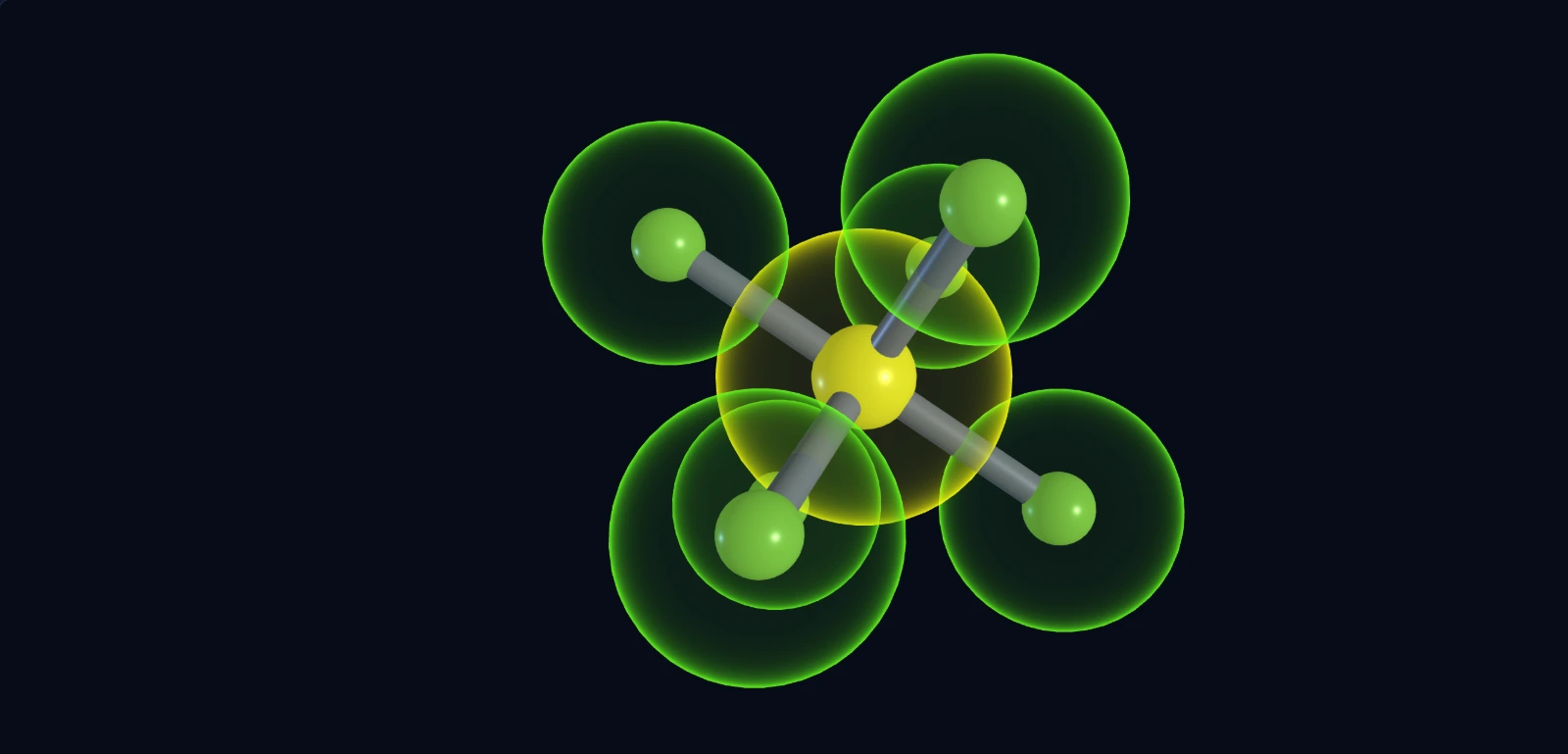
If you like watching simple rules produce structure rather than being told what the structure is, building molecules out of two rules gets tetrahedral methane and a cyclohexane chair out of bond lengths and inverse-square repulsion, with no table of angles anywhere.


Comments